

Imagine two friends, Joe and Alex. They earn similar incomes and both want a comfortable retirement. Joe keeps telling himself he will start investing after the next raise. Alex decides he cannot wait for the perfect time, so he begins with $200 a month.
A year passes. Then five. Alex's account does not suddenly make him rich. Some years the market rises. Some years it falls. But one thing quietly changes: he has built a habit.
Thirty years later, the difference is not that Alex found a secret investment. He simply started, stayed consistent, and gave compounding time to work.
So, can $200 a month really grow into something meaningful?
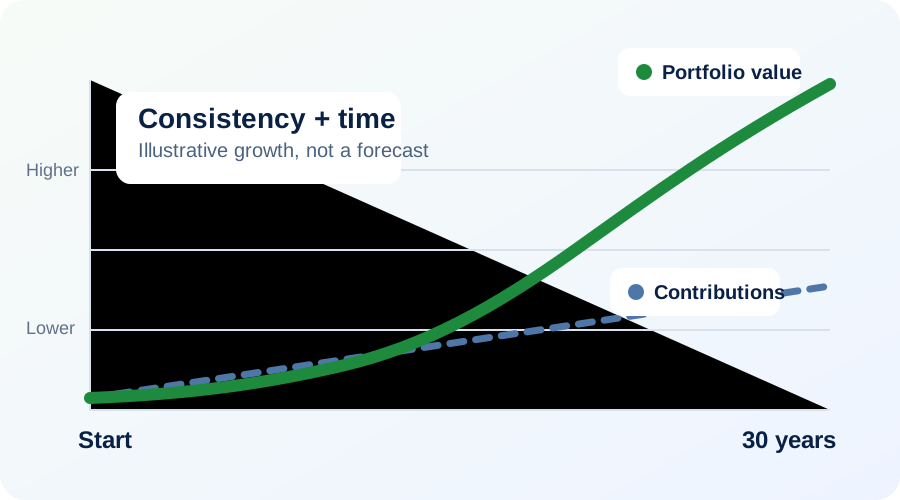
Yes—but it helps to keep the expectations realistic. Over 30 years, investing $200 every month means you personally contribute $72,000. What happens beyond that depends heavily on the return your investments actually earn.
| Average annual return | Your contributions | Illustrative value after 30 years | Illustrative growth |
|---|---|---|---|
| 6% | $72,000 | $200,903 | $128,903 |
| 8% | $72,000 | $298,072 | $226,072 |
| 10% historical reference | $72,000 | $452,098 | $380,098 |
| 12% | $72,000 | $698,993 | $626,993 |
| 15% | $72,000 | $1,384,656 | $1,312,656 |
Assumes $200 invested at the end of each month, monthly compounding, and a constant hypothetical return. Real markets do not deliver a smooth return every month or every year.
Why show 10%?
Historically, the S&P 500 has returned roughly 10% per year on average over the long term. That does not mean investors receive 10% every year. Individual years can be much better—or much worse—and future results may be lower than the historical average.
That is why our calculator lets you test several assumptions instead of relying on one optimistic number. A lower assumption can help you see a more conservative outcome, while a higher assumption shows how sensitive the result is to market performance.
Historical returns do not guarantee future results. For the historical reference used here, see Fidelity's S&P 500 average-return overview.
Does this mean $200 a month will make you “retire rich”?
Probably not by itself—and that is important to say clearly. Even a strong 30-year result is not automatically enough to fully fund retirement on its own.
But $200 a month can do something very valuable: get you moving. Once the habit exists, you can increase the amount as your income improves, debt falls, or other expenses change.
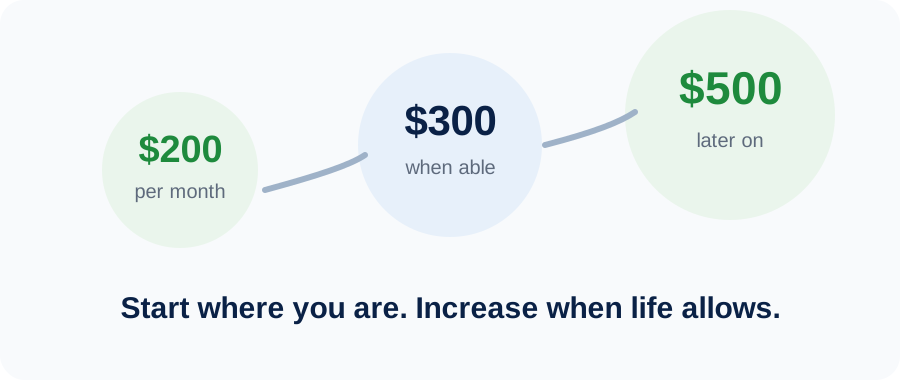
The more realistic path: start at $200, then grow the habit
Instead of asking, “Is $200 enough forever?”, a better question may be, “Can I start with $200 now and increase it later?”
For example, someone might begin with $200 a month, move to $300 after a raise, and eventually reach $500 or more. The exact numbers will be different for every household. The principle is what matters: start with an amount you can sustain, then improve it over time.
What Joe eventually learned from Alex
Joe's mistake was not that he earned too little. It was waiting for the day when investing would feel easy.
Alex's advantage was not a perfect portfolio. It was thirty years of small decisions that kept moving in the same direction.
That is the idea behind Start Small Retire Rich: you do not need to begin with a fortune. You need a reasonable starting point, patience, and a plan you can continue.
What could your monthly investment become?
Change the monthly amount, years, starting balance, and return assumption in our free calculator.
Open the Investment CalculatorThree simple takeaways
- Starting matters. Waiting for the perfect time can cost years of compounding.
- Consistency matters. A repeatable monthly habit is more useful than an ambitious plan you cannot maintain.
- Increasing contributions matters. $200 can be the starting point rather than the finish line.
This article is for educational purposes only and is not financial, tax, or investment advice. The calculations are hypothetical illustrations and do not account for taxes, fees, inflation, changing returns, or sequence-of-returns risk. Investing involves risk, including possible loss of principal.