One of the most common beginner questions is also one of the most important: Should I save money first, pay off debt, or start investing now?
The answer is usually not an all-or-nothing choice. Saving and investing have different jobs. Savings helps protect money you may need soon. Investing accepts market risk in exchange for the possibility of long-term growth. A strong beginner plan gives each dollar a job based on when you may need it and what financial problem it needs to solve.
Prefer to watch? Save or invest first, explained simply
This Start Small Retire Rich video walks through the same beginner decision: when to build savings, handle high-interest debt, use a workplace retirement match, and begin investing for long-term goals.
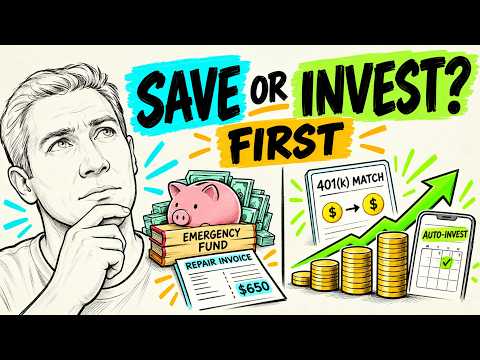
Click the video image to watch on YouTube.
The short answer: build a foundation, then invest consistently
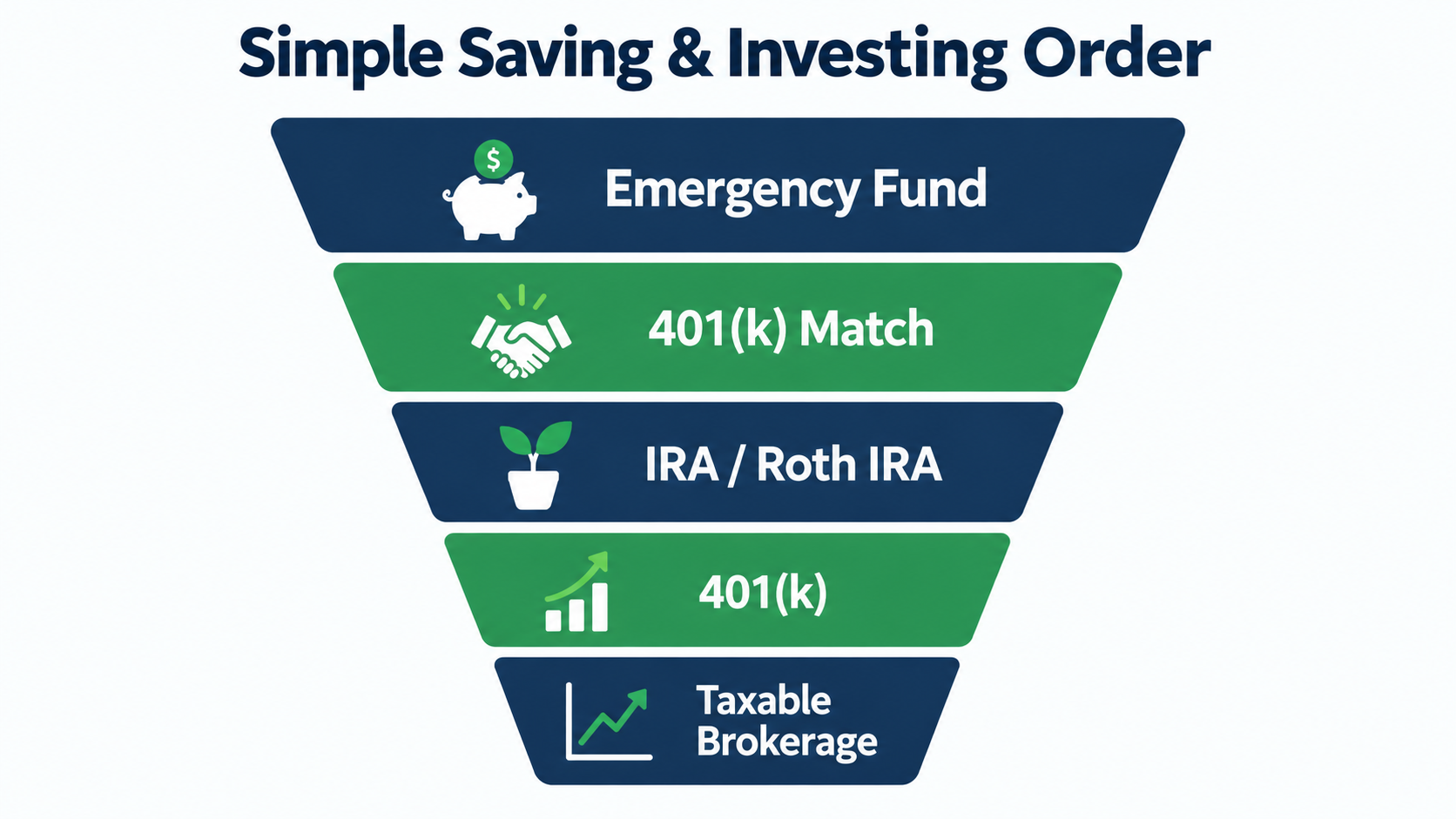
For many beginners, a practical order looks like this:
- Cover essential monthly expenses. Make sure housing, food, utilities, insurance, transportation, and minimum debt payments are manageable.
- Build a starter emergency fund. Create a cash cushion for the unexpected so every surprise does not become new debt.
- Review your workplace retirement match. If your employer offers matching contributions, understand the formula and vesting rules.
- Attack high-interest debt. Credit-card interest can work against you much faster than long-term investing can reliably work for you.
- Grow your emergency savings and invest for long-term goals. Once the foundation is stronger, automate contributions you can realistically maintain.
This is a framework, not a law. A person with very stable income and no dependents may use a different emergency-fund target than a single-income household. Someone with a generous 401(k) match may choose to contribute enough to receive the match while also paying down expensive debt. The goal is to understand the tradeoffs rather than copy a rigid formula.
Saving and investing are not the same thing
Saving is generally for money you may need in the short term or for emergencies. The priority is accessibility and stability. Investing is generally for money you can leave alone for years, where short-term price swings are acceptable because the goal is long-term growth.
| Question | Saving | Investing |
|---|---|---|
| Main purpose | Safety and near-term needs | Long-term growth |
| Typical time horizon | Short term | Years or decades |
| Value can fall with the stock market? | Not if held as insured bank/credit-union deposits within applicable limits | Yes |
| Best use | Emergency fund, planned near-term expenses | Retirement and other long-term goals |
The SEC's Investor.gov notes that savings accounts can be appropriate for short-term goals and emergency funds, while investing is used to pursue longer-term wealth building. That distinction is the foundation of the save-versus-invest decision.
Source: Investor.gov — Introduction to Investing
Step 1: make sure your monthly essentials are covered
Before deciding where to invest, know what is coming in and what is going out. A simple monthly budget does not need dozens of categories. Start with take-home income, essential bills, minimum debt payments, and the amount that is genuinely available for saving or investing.
If investing $200 causes you to put groceries or a utility bill on a credit card, the investment amount is too aggressive for the moment. The goal is a contribution level you can maintain without creating a new financial problem.
Step 2: build a starter emergency fund
An emergency fund is money reserved for unplanned expenses such as a car repair, home repair, medical bill, or temporary loss of income. The Consumer Financial Protection Bureau says even a small amount can help you recover from financial shocks and reduce the chance that an unexpected bill turns into new debt.
There is no universal number that everyone must save before investing. Your target depends on your expenses, job stability, insurance, dependents, and the kinds of surprises your household is likely to face. A beginner can start with a modest cushion and build it over time.
Emergency money should not depend on tomorrow's stock price
If you might need the money next month, it generally should not be exposed to a market decline just when the emergency arrives.
Source: Consumer Financial Protection Bureau — Emergency Fund Guide
Step 3: check whether your employer offers a retirement match
If you have a 401(k) or another employer-sponsored retirement plan, check whether your employer matches some of your contributions. The IRS explains that many plans provide matching contributions when employees contribute from their salary, but the formula and eligibility rules vary by plan.
That makes the workplace match an important piece of the decision. For example, you might decide to contribute enough to receive the available match while still directing additional cash toward emergency savings or high-interest debt. Read your Summary Plan Description or ask your benefits department how your specific match works and whether vesting rules apply.
Source: IRS — Matching Contributions Help You Save More for Retirement
Step 4: take high-interest debt seriously
Credit-card debt can make wealth building much harder because the interest cost is known, while investment returns are uncertain. Investor.gov specifically highlights paying down high-interest credit-card debt as an important step before committing more money to investments.
Suppose a credit card charges 20% annual interest. You cannot count on an investment earning more than 20% every year, and investment returns can be negative. Paying down expensive debt reduces a guaranteed cost, which is why it deserves a high priority in a beginner plan.
This does not mean every loan must be paid off before you invest a dollar. A low-rate mortgage and a high-rate credit card are very different financial obligations. Focus first on the debt that is most expensive and damaging to your monthly cash flow.
Source: Investor.gov — Pay Off Credit Cards or Other High-Interest Debt
Can you save and invest at the same time?
Yes. In real life, the answer is often a split rather than a switch. If you have $200 available each month, for example, you might direct part toward a starter emergency fund, part toward an employer-matched retirement plan, and part toward paying down high-interest debt. As one goal improves, you can redirect more of the same $200 toward the next priority.
The advantage of this approach is behavioral: you begin practicing the habit of long-term investing without ignoring short-term financial stability. The exact percentages are personal; the repeatable system is what matters.
A simple $200-a-month example
Imagine a beginner has $200 left after essential bills and minimum debt payments. They also have a small emergency fund, a workplace retirement match, and some expensive credit-card debt. One possible educational example could look like this:
| Use of the $200 | Example amount | Purpose |
|---|---|---|
| 401(k) contribution | $50 | Work toward available employer match |
| Emergency savings | $50 | Build cash cushion |
| High-interest debt | $100 | Reduce costly balance faster |
This is not a recommended allocation for everyone. It simply shows that “save or invest?” does not always require choosing only one. When the credit-card balance is gone, that $100 could be redirected toward the emergency fund or long-term investing.
When should you start investing more aggressively?
You may be in a stronger position to increase long-term investing when your monthly cash flow is stable, you have some emergency savings, high-interest debt is under control, and the money is intended for a goal that is years away.
At that point, consistency becomes more important than waiting for the “perfect” market entry. Regular investing over a long period gives compounding more time to work, although no return is guaranteed and markets can decline sharply along the way.
What could $50, $100, or $200 a month become?
Use our free calculator to test your own monthly contribution, time horizon, and hypothetical return assumptions.
Open the Investment CalculatorWhat should you invest in once you are ready?
Beginners do not need to begin by finding the next winning stock. A diversified fund can spread your money across many companies at once. One example many beginners research is an S&P 500 ETF such as VOO, which owns shares of large U.S. companies through a single fund.
That does not make VOO or any ETF automatically right for everyone. Your investment should fit your account, goals, time horizon, diversification needs, and ability to tolerate losses.
For a plain-English explanation, read What Is VOO? A Beginner's Guide to the Vanguard S&P 500 ETF.
Five mistakes beginners can avoid
- Investing the emergency fund. Money needed for a near-term surprise should not rely on the stock market being up.
- Ignoring expensive debt. High-interest balances can quietly undo progress elsewhere.
- Missing a valuable employer match without checking the plan. Learn the formula before deciding how much to contribute.
- Waiting until you feel rich. Once your foundation is reasonable, small recurring investments can start building the habit.
- Trying to fix everything in one month. Financial stability is usually built in stages.
A beginner decision checklist
Before your next contribution, ask yourself:
- Are my essential bills covered without adding new debt?
- Do I have some cash available for an unexpected expense?
- Does my employer offer a retirement match, and do I understand the rules?
- Am I carrying high-interest credit-card or similar debt?
- Is the money I want to invest truly for a long-term goal?
- Can I keep contributing this amount even when the market falls?
If those questions are becoming easier to answer, you are not just choosing an investment—you are building a financial system.
Where should you go next?
Once your foundation is in place, the next question is often how much to contribute. Continue with How Much Should I Invest Each Month?.
If you are ready for the mechanics of making your first investment, read How to Start Investing With $100. If you want to understand why time matters, see $200 a Month: Start at 25 vs. 35 vs. 45.
And if broad-market ETFs are new to you, continue with our VOO beginner guide.
Save or invest first: beginner FAQ
Should I save or invest first?
For many beginners, the first priorities are covering essential expenses, building some emergency savings, understanding any workplace retirement match, and addressing high-interest debt. Long-term investing can then grow alongside a stronger financial foundation.
How much should I save before investing?
There is no universal number. Your emergency-savings target depends on your expenses, income stability, dependents, insurance, and likely unexpected costs. Starting with a smaller cushion and building it over time can be more realistic than waiting for a perfect number.
Should I pay off credit-card debt before investing?
High-interest credit-card debt is often a major priority because its cost is known while investment returns are uncertain. An employer retirement match can make the order more nuanced, so review your plan and personal situation.
Can I save and invest at the same time?
Yes. Many people divide available money among emergency savings, debt repayment, and long-term investing, then redirect more money as each goal improves.
Where should I keep an emergency fund?
Emergency money is generally intended to be liquid and protected from stock-market swings. Many people use an insured bank or credit-union savings account or another appropriate cash option.
This article is for educational purposes only and is not financial, tax, legal, or individualized investment advice. Investing involves risk, including possible loss of principal. Employer retirement plans, debt terms, account features, and tax rules vary. Consider your own financial circumstances and verify current information before making financial decisions.