If you are new to investing, you may keep seeing three letters: VOO. It appears in YouTube videos, retirement discussions, brokerage screens, and lists of popular ETFs. But what exactly are you buying when you buy VOO?
VOO is the ticker symbol for the Vanguard S&P 500 ETF. Instead of trying to choose one company that might become the next big winner, VOO gives you exposure to a broad group of large U.S. companies through one fund.
Prefer to watch? Learn VOO in plain English
This Start Small Retire Rich video explains what VOO is, how it follows the S&P 500, why diversification matters, and the risks beginners should understand before investing.
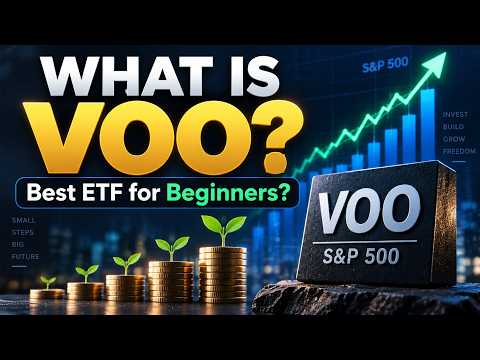
Click the video image to watch on YouTube.
What does VOO actually track?
VOO is designed to track the S&P 500 Index. The S&P 500 represents roughly 500 leading U.S. companies and is one of the most widely followed measures of the U.S. stock market.
When you buy one share—or a fractional share if your brokerage supports it—you are not buying the index itself. You are buying shares of an ETF that holds stocks in an effort to closely follow that index.
Think of VOO as a basket
Instead of putting your entire investment into one company, the basket contains hundreds of companies. The largest companies receive larger weights, so VOO is diversified across many businesses but is not equally weighted.
Why do beginners hear about VOO so often?
There are three main reasons: simplicity, diversification, and low cost. A beginner can learn one fund rather than trying to research dozens of individual stocks. The fund spreads exposure across many large companies, and its annual operating cost is very low compared with many actively managed funds.
As of 2026, Vanguard lists VOO's expense ratio at 0.03%. An expense ratio is the annual operating cost of the fund, expressed as a percentage of assets. At 0.03%, that works out to about $3 per year for every $10,000 invested, before considering changes in account value.
Fund details can change. Verify the latest information on the official Vanguard VOO fund page.
What companies does VOO own?
VOO owns stocks represented in the S&P 500. That means your investment is spread across major U.S. businesses in technology, financial services, health care, consumer products, industrials, communications, energy, utilities, real estate, and other sectors.
The exact companies and their weights change over time as markets move and as the S&P 500 changes. Because the index is weighted by market capitalization, the largest companies can have a meaningful influence on VOO's performance.
Does VOO mean I own “the whole stock market”?
No. This distinction is important. VOO covers the large-company portion of the U.S. market, but it does not intentionally include every small and mid-sized U.S. company, and it does not provide broad international stock exposure.
A total U.S. stock-market ETF can hold large-, mid-, and small-cap companies. An international fund can add companies outside the United States. Whether you need those exposures depends on your overall investing plan, not on whether VOO is “good” or “bad.”
How can VOO make money for an investor?
There are two basic sources of return. First, the market value of the underlying companies may rise over time, which can increase VOO's share price. Second, many companies in the fund pay dividends, and VOO passes along eligible income to shareholders through distributions.
Dividends are not free money—the share price and total return reflect the economics of those distributions—but reinvesting them can help keep more of your money working over long periods.
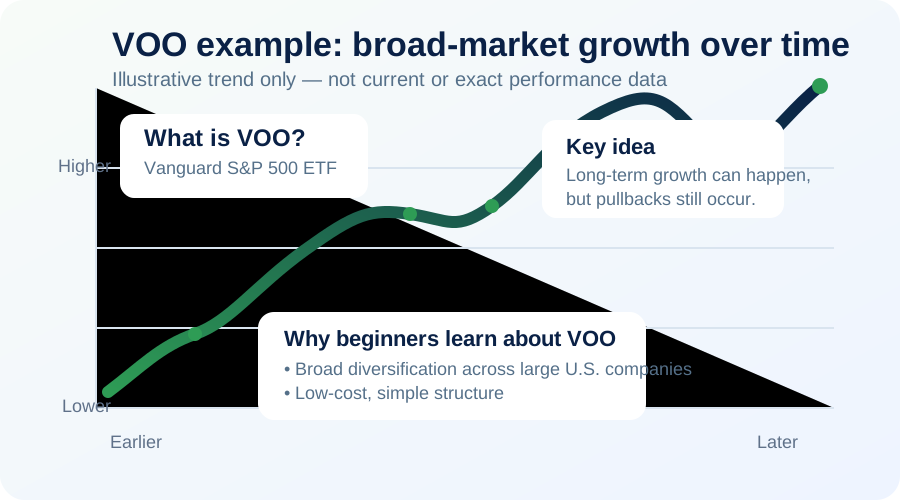
Can VOO go down?
Absolutely. VOO is a stock investment, not a savings account. During recessions, bear markets, financial crises, or other periods of uncertainty, large U.S. stocks can fall substantially. A diversified fund can reduce the damage caused by one individual company failing, but it cannot remove market-wide risk.
This is why money needed for next month's rent, an emergency, a near-term home purchase, or another short-term need generally has a different job from long-term investment money.
VOO versus buying one stock
| Question | VOO | One individual stock |
|---|---|---|
| How many companies? | Hundreds of large U.S. companies | One company |
| Company-specific risk | Spread across many holdings | Highly concentrated |
| Research burden | Understand the fund and index | Understand the individual business deeply |
| Can it lose money? | Yes | Yes |
| Chance one company destroys the whole investment? | Much lower because of diversification | Much higher |
This does not mean individual stocks are automatically wrong. It means they create a different kind of risk. For a beginner who mainly wants broad exposure rather than a stock-picking hobby, an index ETF can be easier to understand and maintain.
VOO versus a savings account
A savings account is designed for stability and liquidity. VOO is designed for market participation and long-term growth potential. The tradeoff is that VOO's value fluctuates and can be lower when you need the money.
That is why an emergency fund and a long-term investment account should not be confused. The first protects your short-term financial life; the second accepts risk in pursuit of longer-term growth.
How much money do you need to start?
The answer depends on your brokerage. Some brokerages allow fractional ETF shares, which can let you invest a specific dollar amount even when one full share costs more than that amount. Vanguard also states that its ETFs can be purchased at Vanguard for as little as $1 using fractional shares.
The more useful question for a beginner is usually not “Can I afford one full share?” but “How much can I invest consistently without creating financial stress?”
A simple $100 or $200 example
Imagine that you have your emergency savings in place, understand the account you are using, and decide that a broad S&P 500 ETF fits your long-term plan. If your brokerage supports fractional shares, you could invest $100 or $200 without waiting until you can afford a full share.
Then, rather than trying to predict the perfect day to buy, you could focus on building a repeatable contribution habit that fits your budget. The habit matters because a single small purchase is only the beginning.
What could consistent monthly investing become?
Use our free calculator to test different monthly amounts, time horizons, and hypothetical annual returns.
Open the Investment CalculatorWhat are the biggest risks of VOO?
- Market risk: The overall U.S. stock market can decline sharply.
- Large-company concentration: VOO focuses on large U.S. companies rather than the entire global market.
- Top-holding concentration: Because the index is market-cap weighted, the largest companies can make up a significant share of the fund.
- Behavior risk: An investor can still hurt long-term results by panic-selling during downturns or repeatedly chasing recent performance.
- Goal mismatch: Even a diversified ETF can be inappropriate for money needed in the near future.
Is VOO a complete retirement portfolio?
For some investors, VOO may be one important building block. But “one fund is simple” is not the same as “one fund is automatically complete.” A retirement portfolio may also include bonds, cash reserves, smaller U.S. companies, international stocks, or other assets depending on age, goals, risk tolerance, and the accounts available.
The right allocation is personal. The important beginner lesson is to understand what each investment contributes to the portfolio rather than collecting funds simply because they are popular.
VOO, VTI, and SPY: are they the same?
They are related, but not identical. VOO and SPY both seek to track the S&P 500, while VTI seeks to track a much broader U.S. stock-market index that includes large-, mid-, and small-cap companies. Their structures, costs, trading characteristics, and exact holdings differ.
For a long-term beginner, the better question is usually not “Which ticker won this month?” but “Which fund matches the exposure I want, at a cost I understand, in an account that fits my goal?”
How to buy VOO in five beginner steps
- Choose the account. Decide whether the money belongs in a workplace retirement account, IRA/Roth IRA, taxable brokerage account, or another appropriate account.
- Fund the account. Transfer money you can afford to keep invested for the intended time horizon.
- Search for ticker VOO. Confirm that you are viewing the Vanguard S&P 500 ETF before placing an order.
- Choose your dollar amount or shares. Fractional-share availability depends on the brokerage.
- Build a repeatable plan. Consider automating future contributions if that fits your budget and brokerage features.
Should a beginner buy VOO?
VOO can be an excellent fund to learn about because it demonstrates several important investing concepts at once: diversification, index investing, low costs, dividends, market risk, and long-term discipline.
Whether you personally should buy it depends on your financial situation, goals, time horizon, tax considerations, other investments, and ability to tolerate losses. No ETF is appropriate for everyone.
Where should you go next?
Not sure whether your next dollar should go to savings, debt, or investing? Read Should You Save or Invest First? for a simple beginner roadmap.
If you are just getting started, read How to Start Investing With $100 for the full step-by-step process, including emergency savings, account selection, diversification, and automation.
If you want to understand why starting earlier matters so much, see $200 a Month: Start at 25 vs. 35 vs. 45. Then use the investment calculator to test your own contribution amount.
VOO beginner FAQ
What does VOO stand for?
VOO is the ticker symbol for the Vanguard S&P 500 ETF.
Does VOO pay dividends?
Yes. VOO distributes income received from its underlying holdings. Distribution amounts vary and are not guaranteed.
Is VOO risk-free?
No. Its market price can decline, and investors can lose money.
Can I buy VOO with $100?
If your brokerage supports fractional ETF shares, you may be able to invest a fixed dollar amount such as $100 rather than buying a full share.
Is VOO the entire U.S. stock market?
No. It tracks the S&P 500, which focuses on large U.S. companies. Broader total-market funds include smaller companies too.
This article is for educational purposes only and is not financial, tax, legal, or individualized investment advice. Investing involves risk, including possible loss of principal. Fund fees, holdings, brokerage features, and tax rules can change. Verify current information before making financial decisions.