You are ready to start investing. Maybe you have $200 a month, and you keep hearing two phrases: index fund and ETF. Which should you choose?
The surprising answer is that you might not have to choose between them. An ETF can also be an index fund. Let’s clear up the terminology and focus on what actually matters: what you own, what it costs, and whether it fits your long-term plan.
First, what is a fund?
Imagine wanting to invest in hundreds of companies without buying their stocks one by one. A fund pools investors’ money and owns a collection of investments. When you buy a share of the fund, you gain exposure to that collection. Some funds hold stocks, others hold bonds, and some combine different investments.
A broad fund can reduce the risk of relying on one company, but it can still lose money when markets fall. A narrowly focused fund may offer much less diversification than its name suggests.
What is an index fund?
An index fund aims to follow a defined market index, such as the S&P 500 or a total U.S. stock-market index. Rather than asking a manager to pick the next winning stock, it follows a rules-based benchmark, with the goal of delivering approximately the index’s performance before fees and tracking differences.
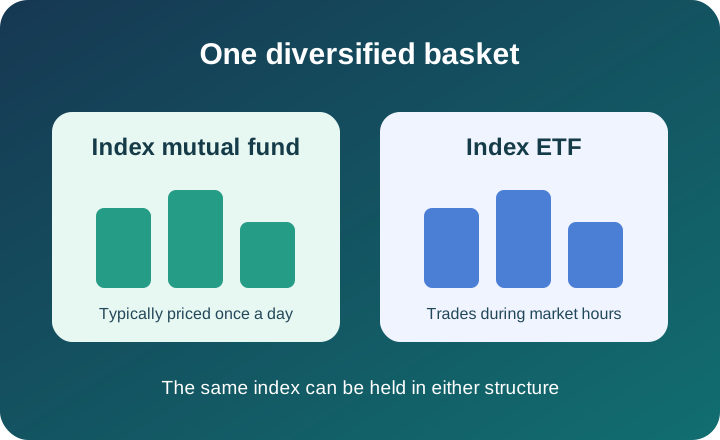
Index funds can be structured as mutual funds or ETFs. This is the most important idea to understand before comparing the two terms.
Source: SEC Investor.gov — Index Funds.
What is an ETF?
An exchange-traded fund (ETF) is a fund whose shares investors buy and sell on a stock exchange during market hours, much like a stock. Many ETFs track indexes. Some, however, are actively managed or focus on a specific industry, theme, commodity exposure, or other strategy.
An ETF’s market price changes throughout the trading day and may differ slightly from the value of its underlying holdings. Some brokerage platforms offer fractional shares and automatic recurring ETF purchases, while others do not.
The comparison that actually helps: index mutual funds vs. index ETFs
For a fair comparison, imagine two funds tracking the same index: one is an index mutual fund, and the other is an index ETF.
| Feature | Index mutual fund | Index ETF |
|---|---|---|
| Investment strategy | Tracks a selected index | Can track the same index |
| When it trades | Orders typically execute at the day’s closing net asset value (NAV) | Trades throughout market hours at market prices |
| Starting amount | Some funds have purchase minimums; others do not | Generally one share, or less if fractional shares are supported |
| Automatic investing | Often easy to schedule in fixed dollar amounts | Depends on brokerage support |
| Costs | Fund expense ratio; possible account, transaction, or other fees | Fund expense ratio; potential bid–ask spread and trading fees |
| Tax considerations | May distribute taxable capital gains in taxable accounts | Some ETFs are more tax-efficient, but not always |
| Best fit | Someone who values scheduled dollar contributions | Someone who prefers exchange trading or low minimums |
Key takeaway: if both funds track the same index, their underlying exposure may be similar. The buying process, investment minimums, expenses, and tax treatment may differ.
Source: SEC Investor.gov — Characteristics of Mutual Funds and ETFs.
A real example: VOO and an S&P 500 index mutual fund
VOO is Vanguard’s S&P 500 ETF: it seeks to track the S&P 500, which represents large U.S. companies. Vanguard also offers an S&P 500 index mutual fund, with share classes such as VFIAX. These provide a useful example of two fund structures pursuing a similar benchmark.
That does not make either fund the automatic winner. Check the current prospectus for each fund’s expense ratio and minimum investment. Also remember that an S&P 500 fund does not include every U.S. stock, international stocks, or bonds.
Want to understand the ETF example better? Read our beginner’s guide to VOO.
What should you compare before investing?
- What does the fund actually own? A total-market index fund and a single-sector fund can have very different risks.
- How diversified is it? Hundreds of holdings may still concentrate in a few large companies or one country.
- What is the expense ratio? Ongoing fees reduce the return you keep. Also check any commissions, account charges, and trading spreads.
- Is there a minimum investment? An index mutual fund might require an initial amount that exceeds your first $200.
- Can you automate contributions? Recurring fixed-dollar purchases can make the plan easier to follow.
- Where will you hold it? Taxable brokerage accounts and tax-advantaged retirement accounts have different tax rules.
- Does it fit your risk tolerance and time horizon? A stock fund can lose substantial value during a market downturn.
How to start with $200 a month
Suppose you can invest $200 every month after considering emergency savings, expensive debt, and near-term needs. Here is a simple process—not a recommendation for a particular security:
- Choose the account. Consider eligible retirement accounts and employer matching where applicable, or a brokerage account for other goals.
- Research a diversified, low-cost fund. Learn its benchmark, holdings, risks, minimum investment, and total costs.
- Check your broker’s features. If you select an ETF, verify whether fractional shares and recurring buys are supported. If you select an index mutual fund, check any minimums.
- Set a sustainable schedule. $200 a month is an example, not a required starting amount.
- Review periodically. Revisit your allocation as your goal, timeline, and financial circumstances change.
Investing the same amount on a schedule is called dollar-cost averaging. It helps with consistency, but it cannot prevent losses or guarantee better returns.
Three beginner mistakes to avoid
- Assuming every ETF is diversified. Some ETFs are concentrated, complex, or designed for short-term strategies.
- Choosing based on yesterday’s returns. Past performance does not predict future results. Understand the actual holdings and risk.
- Ignoring small costs. Expense ratios, spreads, and fees can add up over years, especially with regular contributions.
Frequently asked questions
Are index funds and ETFs the same thing?
Not exactly. An index fund follows a market index and can be structured as either a mutual fund or an ETF. An ETF describes how a fund is bought and sold.
Can an ETF be an index fund?
Yes. Many ETFs track indexes, including broad stock-market indexes. Other ETFs use active strategies.
Which is better for beginners: ETFs or index mutual funds?
Neither is automatically better. Compare what the fund owns, diversification, expense ratio, trading costs, minimum investment, and how easily you can automate contributions.
Can I invest $200 a month in an ETF?
Often yes, if your brokerage supports fractional ETF shares or a share price fits your contribution. Recurring investment features vary by brokerage.
Are index funds guaranteed to make money?
No. Index funds can lose value, and diversification does not guarantee a profit or prevent market losses.
Is VOO an ETF or an index fund?
Both. VOO is an exchange-traded fund that seeks to track the S&P 500 Index.
So which is better for beginners?
There is no universal winner. A low-cost, diversified index ETF can be an accessible way to start. A low-cost index mutual fund can be equally sensible if its minimums and automatic-investing features suit you. Focus on the fund’s holdings, risks, expenses, and your ability to contribute consistently—not just its label.
What could a monthly investing habit become?
Explore different monthly amounts, investing time horizons, and hypothetical rates of return. The results are illustrations—not forecasts or promises.
Try the Investment CalculatorContinue learning
Start with our first-investment guide, explore what VOO is, or learn how regular monthly investing works.
Educational information only. This content is not personalized financial, investment, tax, or legal advice. Examples and fund names are illustrative, not endorsements. All investments can lose value, including principal.