
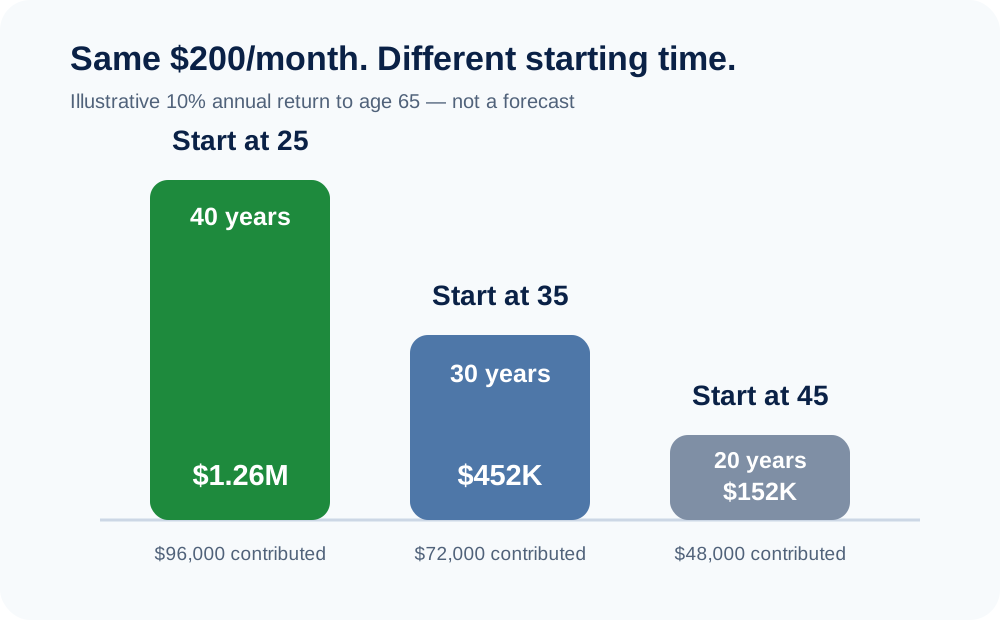
Meet Emma, Mike, and David. All three want to retire around age 65. They each decide they can begin with $200 a month. Emma starts at 25, Mike at 35, and David at 45.
They are not trying to beat the market every month. They are not constantly changing investments. For this simple illustration, they just keep contributing the same amount and give the money time to compound.
At first, the difference does not look dramatic. After a few years, though, time begins doing more and more of the work.
Why Starting at 25 Beats Starting at 35 or 45
If you prefer a visual explanation, watch our Start Small Retire Rich video that walks through why starting earlier can make such a large difference over time.
If you are previewing this page as a local file on your computer, YouTube may block the embedded player. In that case, use the direct YouTube link below.
The same $200 a month—but very different amounts of time
If each person invests until age 65, Emma has 40 years, Mike has 30 years, and David has 20 years.
| Starting age | Years invested | Total contributions | At 8%* | At 10%* |
|---|---|---|---|---|
| 25 | 40 | $96,000 | $698,202 | $1,264,816 |
| 35 | 30 | $72,000 | $298,072 | $452,098 |
| 45 | 20 | $48,000 | $117,804 | $151,874 |
*Hypothetical illustration assuming $200 is invested at the end of every month, returns compound monthly, and the annual return remains constant. Real markets do not behave this smoothly. Taxes, fees, and inflation are not included.
Why is the age-25 result so much larger?
Emma contributes $96,000 over 40 years. David contributes $48,000 over 20 years. So Emma personally puts in only $48,000 more—but in the 10% illustration her ending value is more than $1.1 million higher.
That gap comes from compounding. Returns can potentially earn additional returns, and the effect has more time to build when money is invested earlier.
Why show an 8% and a 10% example?
No one knows what future market returns will be. We use more than one assumption because a retirement plan should not depend on a single optimistic forecast.
Historically, the S&P 500 has returned roughly 10% per year on average over the long term, but year-to-year results vary dramatically and future returns may be lower. The 8% column gives a lower-growth illustration so you can see how much the assumption changes the outcome.
Historical returns do not guarantee future results. For background on the historical S&P 500 reference, see Fidelity's S&P 500 average-return overview.
What if you are already 35 or 45?
This comparison is not meant to make a later starter feel defeated. You cannot go back and invest at 25—but you can decide what happens next.
A person starting later may be able to contribute more than $200, increase contributions after raises, use a workplace retirement plan and employer match when available, or simply stay consistent for the years that remain.
Starting later changes the strategy—not the reason to start.
Less time makes the contribution rate more important. Even at 45, twenty years is still a meaningful investing horizon.
The lesson Mike learned from Emma
Mike did not need to copy Emma's past. He needed to stop waiting. At 35, he still had three decades before 65. Starting then was far more useful than spending another ten years wishing he had begun at 25.
David's lesson at 45 was similar. He could not control yesterday, but he could control whether age 46 arrived with an investing habit or another year of delay.
So when is the best time to start?
If your finances are ready for long-term investing, earlier gives compounding more time. But the practical answer is simpler: the best starting point is the one you can actually begin and sustain.
That is why our philosophy is Start Small Retire Rich. A modest contribution today can become the base for larger contributions later.
Run the numbers for your situation
Use our free calculator to change your current age, retirement age, starting balance, monthly contribution, and return assumption.
Open the Investment CalculatorThree simple takeaways
- Time is powerful. Starting earlier gives each contribution more years to compound.
- Starting later is still starting. At 35 or 45, consistency and increasing contributions can still matter greatly.
- Do not build a plan around one return. Test several assumptions and remember that markets are unpredictable.
This article is for educational purposes only and is not financial, tax, or investment advice. Calculations are hypothetical illustrations and do not account for taxes, fees, inflation, changing returns, or sequence-of-returns risk. Investing involves risk, including possible loss of principal.