
A lot of beginners ask the same question: “I only have $100. Is that even enough to start investing?”
The answer is that the first $100 matters less because of what it can earn immediately and more because of what it can teach you: how to open the right account, choose investments you understand, automate contributions, and stay consistent.
Prefer to watch? Start with your first $200 in five simple steps
This video walks through the beginner process visually: choosing the right account, using diversification instead of trying to pick one big winner, and building a repeatable investing habit.

Click the video image to watch on YouTube. This avoids browser and embedded-player configuration errors.
Step 1: Decide what the money is for
Before choosing an investment, decide when you expect to need the money. Investing is generally better suited to long-term goals because market values can fall sharply over shorter periods.
If the $100 might be needed soon for rent, a car repair, medical costs, or another emergency, keeping it accessible may be more important than investing it.
Step 2: Build some financial breathing room
An emergency fund and an investment account do different jobs. Emergency savings are designed to be available when life surprises you. Long-term investments are designed to accept market risk in pursuit of growth over time.
You do not necessarily need to wait until every financial goal is perfect, but avoid investing money that you already know you may need in the near future.
Step 3: Choose the account before the investment
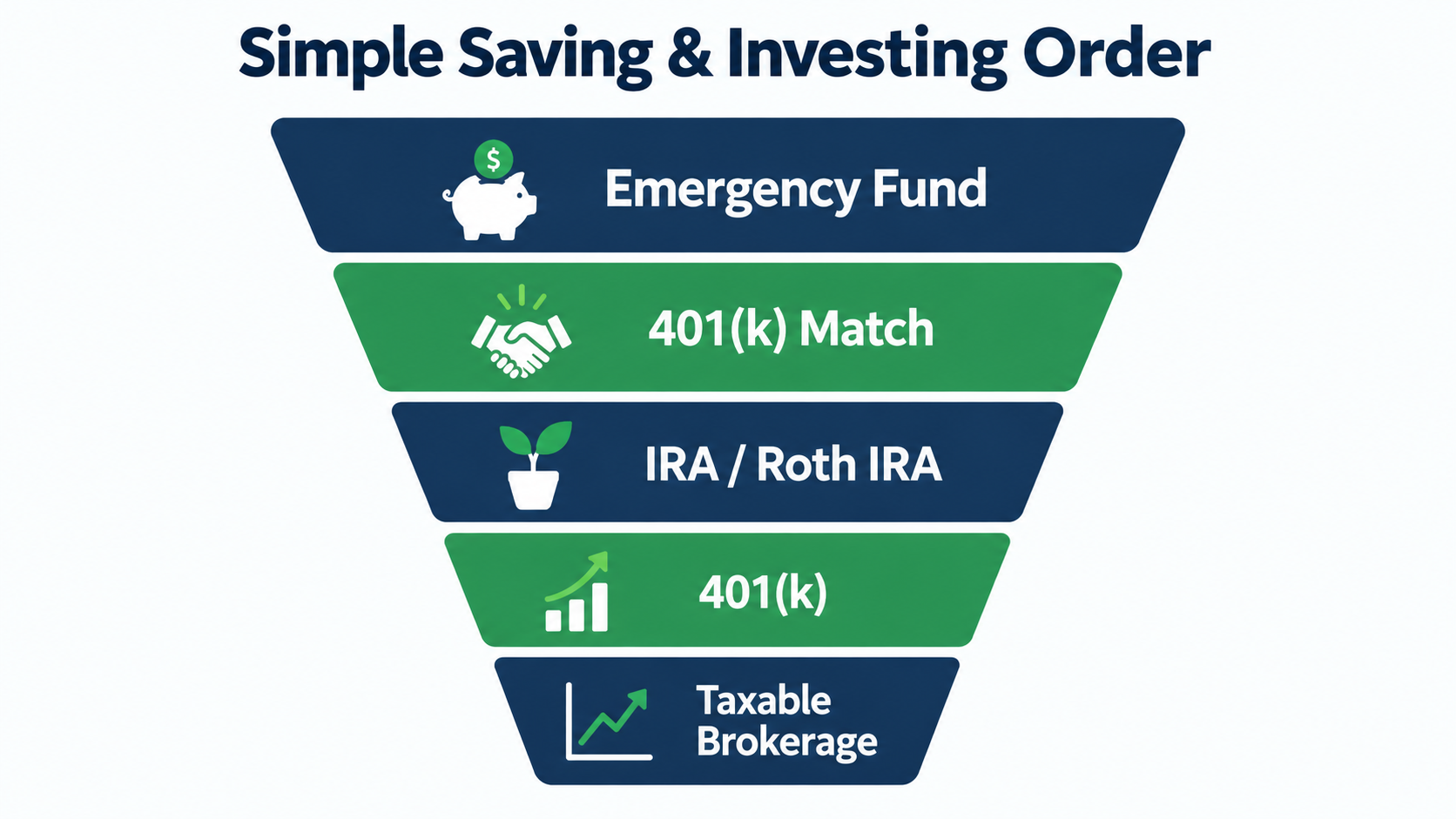
Think of an investment account as the container and the investment as what goes inside it. Depending on your situation, you may have choices such as a workplace retirement plan, an IRA, a Roth IRA, or a regular taxable brokerage account.
Tax rules, eligibility, employer matching, and withdrawal rules differ by account type. For retirement money, learning about available tax-advantaged accounts can be just as important as choosing the fund itself.
Workplace plan available?
If your employer offers a retirement-plan match, understand how it works before deciding where your first long-term investing dollars should go. A match can materially affect the value of participating.
Step 4: Keep the first investment simple
A beginner does not need a portfolio full of individual stocks. One place to begin your education is with diversified funds that hold many companies rather than depending on the success of a single business.
Broad-market index funds and ETFs are common examples of diversified investments. Before buying anything, understand what the fund owns, its costs, its risks, and whether its investment objective fits your time horizon.
Step 5: Understand ETFs and index funds
An ETF, or exchange-traded fund, can hold a basket of investments and trades on an exchange. An index fund is designed to track a particular market index. Some index funds are ETFs, while others are mutual funds.
The important beginner idea is not the label. It is diversification: spreading your money across many holdings can reduce the risk of depending on one company, although it cannot eliminate the possibility of loss.
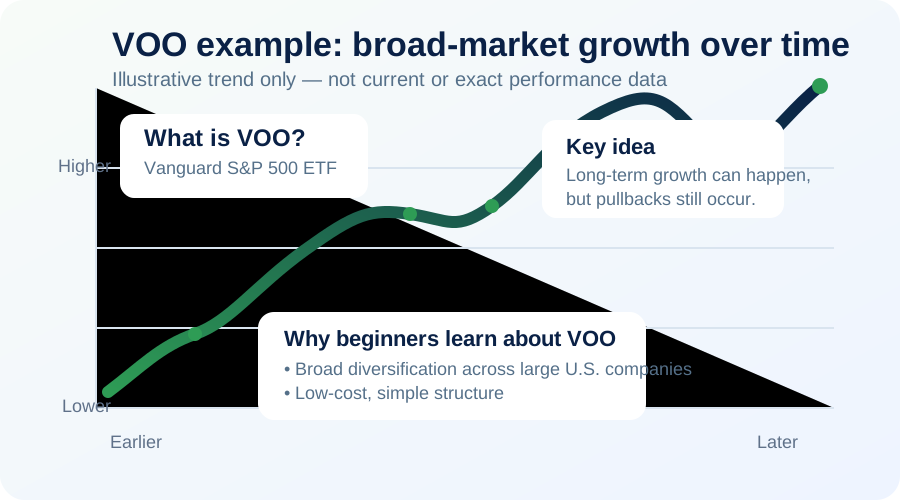
One well-known example beginners often learn about is VOO, the Vanguard S&P 500 ETF. VOO is designed to track the S&P 500, which means it gives investors exposure to hundreds of large U.S. companies through a single fund.
That does not make it risk-free, and it does not guarantee future returns. But it is a good example of why diversified index-based investing is easier for many beginners to understand than trying to pick a single winning stock.
For the latest official fund details and performance information, see the Vanguard VOO fund page.
Step 6: Put the $100 to work—and plan the next $100
Suppose you invest your first $100 and stop forever. That is a start, but it is unlikely to transform your retirement by itself. The real power comes from making the next contribution, and then the next one.
For example, you might begin with $100 today and then automate $25, $50, $100, or $200 per month—whatever genuinely fits your budget. As your income grows, you can revisit the amount.
What could a monthly habit become?
Try different monthly contribution amounts and hypothetical returns with our free investment calculator.
Open the Investment CalculatorStep 7: Automate the habit when practical
Automation can remove a recurring decision from the process. Instead of asking every month whether you feel like investing, you can make a scheduled contribution part of your normal budget.
The amount does not have to impress anyone. A smaller contribution you can sustain is usually more useful than an aggressive amount that forces you to stop after a few months.
Step 8: Expect the market to go down sometimes
Beginning investors often understand market gains before they emotionally understand market losses. A diversified investment can still decline, sometimes substantially.
That is one reason your time horizon and risk tolerance matter. A long-term plan should be built with the expectation that difficult markets will occur—not with the assumption that every year will be positive.
Five common beginner mistakes
- Waiting for the perfect time. Nobody consistently knows the best day to enter the market.
- Investing emergency money. Market risk and short-term cash needs are a poor combination.
- Putting everything into one stock. Concentration can create much larger company-specific risk.
- Chasing whatever recently went up. Recent performance is not a guarantee of future results.
- Ignoring fees and taxes. Costs and account structure can affect long-term results.
What if you can invest $200 a month later?
This is where starting small can become powerful. Your first $100 teaches you the process. Your future monthly contributions do most of the heavy lifting.
We illustrated this in our article How to Retire Rich by Investing $200 a Month for 30 Years. You can also see why starting age matters in $200 a Month: Start at 25 vs. 35 vs. 45.
A simple first-$100 checklist
- Make sure the money is for a long-term goal.
- Keep appropriate emergency cash accessible.
- Understand your workplace retirement plan, if you have one.
- Choose an account that fits the goal.
- Learn about diversified, low-cost investment choices.
- Invest an amount you can afford to leave invested.
- Set a realistic recurring contribution.
- Increase that contribution when your budget allows.
Your first goal is not to find the perfect investment.
Your first goal is to understand what you are doing well enough to begin, then build a long-term process you can continue through good markets and bad ones.
This article is for educational purposes only and is not financial, tax, legal, or individualized investment advice. Investing involves risk, including possible loss of principal. Investment products, account rules, taxes, and eligibility can change; verify current details before making financial decisions.