Once you decide to start investing, the next question usually arrives immediately: How much should I invest each month?
You will see many rules online: 10% of income, 15%, 20%, or a fixed dollar amount. Those can be useful reference points, but they are not universal answers. Your monthly investing amount should fit your income, expenses, emergency savings, debt, goals, and time horizon.
Prefer to watch? See how much you should invest each month
This Start Small Retire Rich video walks through the same beginner-friendly idea: choose a monthly amount that fits your real budget, make it sustainable, and increase it over time when you can.
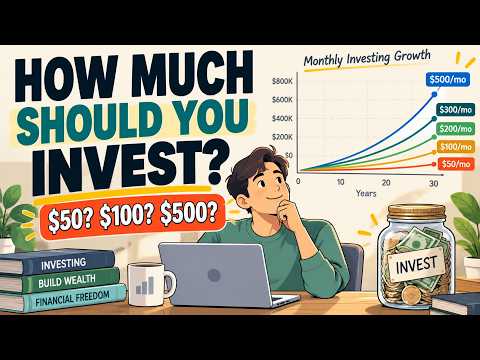
Click the video image to watch on YouTube.
The short answer: start with an amount you can sustain
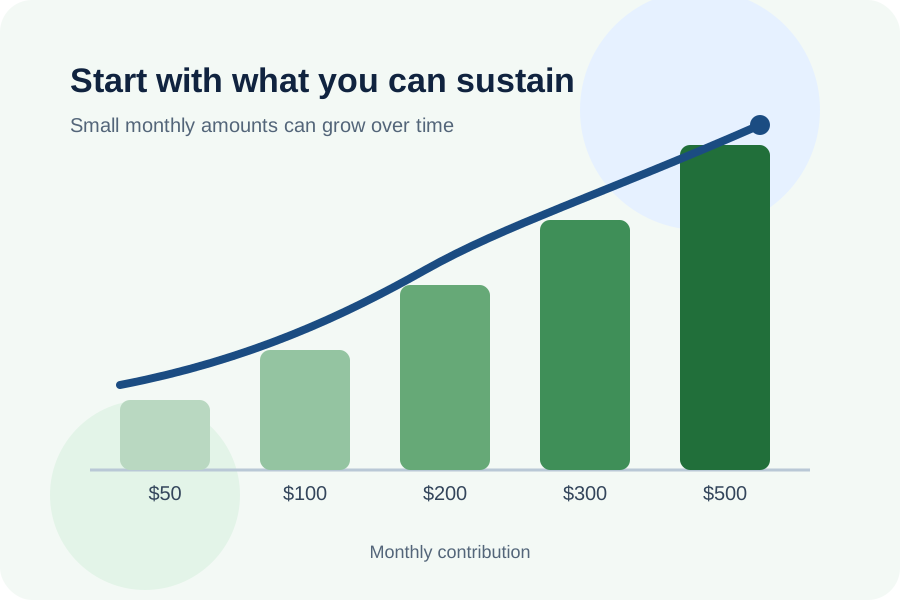
If $50 a month is comfortable, start with $50. If $100 or $200 fits your budget, that is a stronger start. If you can invest more without relying on credit cards or draining your emergency savings, you can choose a larger amount.
The key is to build a contribution you can repeat during ordinary months, expensive months, and market downturns. Consistency gives compounding time to work.
There is no magic monthly investing number
A person earning $45,000 and supporting a family may have a very different monthly investing capacity than someone earning $120,000 with low fixed expenses. That is why a fixed rule can be misleading.
Instead of asking, “What number is everyone else using?” ask three questions:
- What can I invest without creating new debt?
- What amount can I keep contributing consistently?
- Will this amount move me toward my long-term goal?
What could $50, $100, $200, or $500 a month become?
Here is a simple illustration using a hypothetical 8% annual return, compounded monthly, for 30 years. This is not a forecast or guarantee. Real investment returns vary and can be negative.
| Monthly investment | Total contributed | Hypothetical value after 30 years |
|---|---|---|
| $50 | $18,000 | About $74,500 |
| $100 | $36,000 | About $149,000 |
| $200 Start Small Retire Rich example | $72,000 | About $298,000 |
| $300 | $108,000 | About $447,000 |
| $500 | $180,000 | About $745,000 |
Illustration assumes end-of-month contributions and a constant 8% annual return compounded monthly. It excludes taxes, fees, inflation, and market volatility.
This table shows why a small starting amount is not meaningless. It also shows why increasing your monthly contribution over time can make a large difference.
Should you invest 10%, 15%, or 20% of your income?
Percentage guidelines can help you think about your budget, but they should be treated as planning tools—not commands. A target such as 10% or 15% may be realistic for one household and impossible for another.
A better approach is to start with your real cash flow. After essential expenses, appropriate emergency savings, and high-interest debt obligations, decide how much can go toward long-term investing without making your monthly finances fragile.
Remember the previous step
If you are still deciding whether your next dollar should go to savings, debt, or investing, read Should You Save or Invest First? before choosing your monthly investment amount.
What if you can only invest $50 or $100 a month?
That is still a real start. One of the biggest beginner mistakes is waiting until there is “enough” money to make investing worthwhile. Waiting can cost you something that cannot be replaced later: time.
If $50 is what fits today, begin there and create a habit. When your income increases or an expense disappears, raise the contribution. For example:
- Start at $50 per month.
- Move to $75 after a raise.
- Increase to $100 after paying off a small debt.
- Continue gradually toward $150 or $200 as your budget improves.
You do not need to jump from zero to an aggressive savings rate overnight.
What if you can invest $200 a month?
$200 a month is the core example behind Start Small Retire Rich because it is large enough to demonstrate the power of long-term compounding while still being a realistic goal for many people.
We explore that idea in detail in How to Retire Rich by Investing $200 a Month for 30 Years and show how starting age can change the result in $200 a Month: Start at 25 vs. 35 vs. 45.
Use your goal to test whether your monthly amount is enough
A sustainable starting amount is important, but eventually you should connect that amount to a goal. Ask:
- How much do I want to accumulate?
- How many years do I have?
- How much have I already invested?
- What return assumption am I using?
Then test different monthly contributions instead of relying on a generic rule.
Try your own numbers
Change your age, monthly contribution, starting balance, and assumed return in the Start Small Retire Rich calculator.
Automate the amount you choose
Once you choose a sustainable amount, automation can turn the decision into a routine. If your brokerage or retirement account supports recurring contributions, consider scheduling the transfer around payday so investing does not depend on remembering every month.
The goal is simple: make investing a normal part of your monthly cash flow rather than something you do only when extra money happens to remain.
Increase your investment when your financial life improves
Your first contribution does not need to be your forever contribution. Look for natural opportunities to increase it:
- After a salary increase.
- After paying off a car loan or credit-card balance.
- After reducing a recurring expense.
- After receiving a promotion.
- After building a stronger emergency fund.
Even increasing by $25 or $50 at a time can add up over many years.
Five monthly investing mistakes to avoid
- Investing so much that you need credit cards for normal expenses.
- Using money you may need soon. Stock-market investments can fall at the wrong time.
- Waiting for the “perfect” amount. A smaller sustainable start can be better than years of delay.
- Increasing your return assumption just to make the math look better.
- Never revisiting your contribution. Your monthly amount should evolve as your income and goals change.
A simple beginner framework
If you are unsure where to begin, use this sequence:
- Review your monthly income and essential expenses.
- Make sure your emergency savings and high-interest debt are being addressed.
- Check whether your employer offers a retirement match.
- Choose a monthly investment amount you can comfortably repeat.
- Automate it when practical.
- Increase the amount gradually as your finances improve.
- Recheck your goal at least once a year.
That is the philosophy behind Start Small Retire Rich: start with what you can sustain, stay consistent, and give time a chance to do the heavy lifting.
How much should I invest each month? FAQ
How much should I invest each month?
There is no universal amount. Start with a contribution that fits your budget after essential expenses, appropriate emergency savings, and costly debt, then compare that amount with your long-term goal.
Is $100 a month enough to invest?
Yes. $100 a month can be a meaningful starting point if it is sustainable. You can increase it later as your income or financial situation improves.
Is $200 a month enough to invest?
$200 a month can build meaningful long-term value, but whether it is enough for your specific goal depends on your timeline, starting balance, and actual investment returns.
Should I invest a percentage of my income?
Percentage guidelines can be helpful benchmarks, but they are not universal rules. Your actual amount should reflect your expenses, savings, debt, workplace benefits, and long-term goals.
Should I increase my monthly investment over time?
If your budget allows, gradual increases after raises, debt payoff, or lower expenses can make a significant difference over a long investing horizon.
This article is for educational purposes only and is not financial, tax, legal, or individualized investment advice. Investing involves risk, including possible loss of principal. The growth examples are hypothetical and do not represent guaranteed or expected future returns. Consider your own circumstances and verify current account, tax, and plan information before making financial decisions.