One of the hardest questions for a new investor is surprisingly simple: When should I invest? Today? Next week? After the market drops?
Dollar-cost averaging—often shortened to DCA—is one way to make that decision less emotional. Investor.gov defines it as investing money in equal portions at regular intervals, regardless of market ups and downs.
Watch the video: What Is Dollar-Cost Averaging?
Prefer watching instead of reading? Our video explains dollar-cost averaging for beginning investors.
Watch on YouTube →What is dollar-cost averaging?
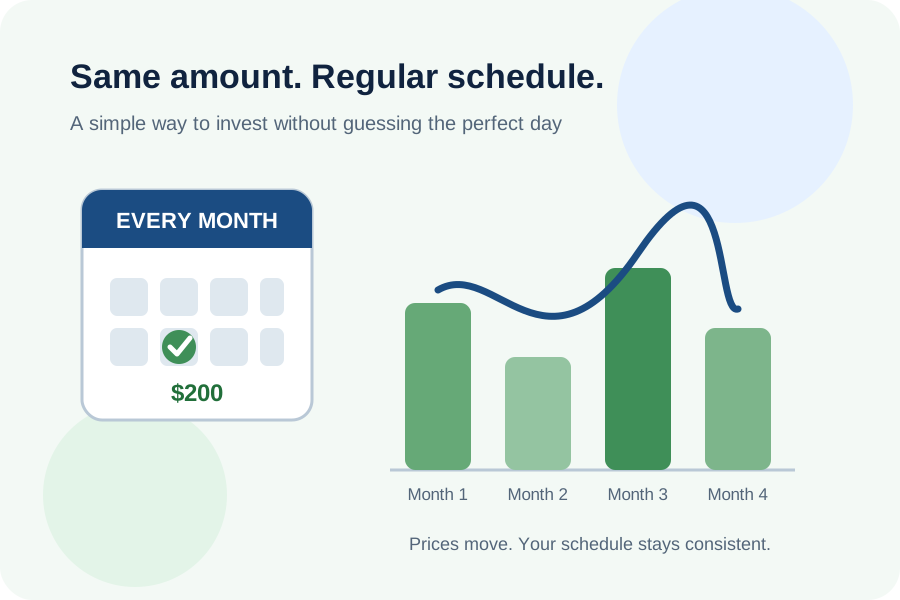
Dollar-cost averaging means choosing a fixed amount—such as $50, $100, or $200—and investing it on a repeating schedule. That schedule might be every payday, once a week, or once a month.
When the investment price is lower, the same dollar contribution buys more shares. When the price is higher, it buys fewer shares. You continue the process without changing the plan simply because the market moved.
Source: Investor.gov — Dollar Cost Averaging.
A simple $200-a-month example
Imagine you invest $200 into the same diversified investment once each month. For simplicity, this example ignores fees and assumes fractional shares are available.
| Month | Investment price | You invest | Approx. shares purchased |
|---|---|---|---|
| Month 1 | $100 | $200 | 2.00 |
| Month 2 | $80 | $200 | 2.50 |
| Month 3 | $125 | $200 | 1.60 |
| Month 4 | $95 | $200 | 2.11 |
You invested the same $200 each month. The number of shares changed because the price changed. That is the basic mechanics of dollar-cost averaging.
Why beginners may like dollar-cost averaging
- It creates a repeatable habit. You decide the amount and schedule ahead of time.
- It reduces market-timing pressure. You do not need to guess whether today is the perfect day to buy.
- It can work naturally with paychecks. Many people contribute to workplace retirement accounts on a recurring schedule already.
- It can be automated. Depending on the brokerage and investment, recurring transfers or purchases may help keep the plan consistent.
Investor.gov summarizes the long-term idea simply: regular investments plus time can build wealth, while reminding investors that markets fluctuate and all investments involve risk.
Source: Investor.gov — Introduction to Investing.
What dollar-cost averaging does not do
DCA is a process, not protection. It does not guarantee a profit, eliminate market losses, or turn a poor investment into a good one.
It also does not mean investing every available dollar slowly is always mathematically better. FINRA notes an important distinction: if you already have a lump sum available, spreading that money out over time can reduce some timing anxiety, but part of the money stays in cash longer and may miss market gains if prices rise.
Source: FINRA — Benefits and Limitations of Dollar-Cost Averaging.
Dollar-cost averaging vs. investing a lump sum
| Situation | Dollar-cost averaging | Lump-sum investing |
|---|---|---|
| You receive money gradually from paychecks | Fits naturally with recurring investing | There may be no large lump sum available |
| You already have a large amount ready to invest | Spreads entry points over time | Puts all available money to work immediately |
| Main emotional benefit | Reduces pressure to choose one entry date | Avoids repeatedly reconsidering future entry dates |
| Main limitation | Cash waiting to be invested may miss gains | Full amount is exposed to market movement immediately |
How to create a simple DCA plan
- Choose the goal. Long-term retirement money is different from money you may need next year.
- Choose an amount you can sustain. Our monthly investing guide can help you think through the number.
- Choose an appropriate diversified investment. Understand what you own, its risks, and its costs.
- Choose the schedule. Monthly or every payday can be easier to maintain than an arbitrary market-based rule.
- Automate when appropriate. Automation can reduce the temptation to skip contributions because of scary headlines.
- Review the plan—not every market move. Revisit your contribution when your income, goals, debt, emergency savings, or time horizon changes.
What if the market falls right after I invest?
That can happen. DCA does not prevent your account balance from falling. If your next scheduled contribution occurs at a lower price, however, the same contribution will purchase more shares. The important question is whether the investment still fits your goal and risk tolerance—not whether every individual contribution is immediately profitable.
Should you invest weekly or monthly?
There is no universal schedule that is best for everyone. A practical approach is to match your investing schedule to your cash flow. If you are paid twice a month, you might invest every payday. If you prefer simpler tracking, a monthly schedule may be easier.
The bigger idea is consistency. A schedule that you can follow for years is more useful than a complicated routine you abandon after a few months.
Dollar-cost averaging and the Start Small Retire Rich idea
Our core message is not that everyone must invest the same dollar amount. It is that small, sustainable contributions can become meaningful when they are repeated over long periods of time.
DCA fits that philosophy because it turns investing from a one-time decision into a habit. You can start with an amount your budget supports and, when your finances improve, increase the recurring contribution.
Want to see what a recurring investment could become?
Use our calculator to test your own starting balance, monthly contribution, time horizon, and hypothetical return.
Try the Investment CalculatorFrequently asked questions
What is dollar-cost averaging in simple terms?
Dollar-cost averaging means investing the same amount of money on a regular schedule, regardless of whether market prices are up or down.
Is dollar-cost averaging good for beginners?
It can be beginner-friendly because it creates a repeatable investing habit and reduces the need to choose a perfect day to invest. It does not remove investment risk or guarantee a profit.
How often should I dollar-cost average?
A schedule can be weekly, every payday, or monthly. The best frequency is usually one that matches your cash flow and can be maintained consistently.
Does dollar-cost averaging guarantee better returns?
No. Dollar-cost averaging does not guarantee gains or prevent losses. If you already have a lump sum available, investing gradually can also mean part of the money remains uninvested while markets rise.
Can I dollar-cost average into an ETF?
Yes. If your brokerage supports recurring purchases or fractional shares, you may be able to invest a fixed dollar amount into an ETF on a regular schedule. Available features and fees depend on the brokerage.
The bottom line
Dollar-cost averaging is simple: invest the same amount on a regular schedule instead of waiting for a perfect market entry. It can make long-term investing easier to automate and easier to stick with, but it does not eliminate risk or guarantee better returns.
For a beginner, the most useful starting point is often not predicting what the market will do next. It is building a realistic plan you can keep following.
Educational information only. This content does not provide individualized financial, investment, tax, or legal advice. Investing involves risk, including possible loss of principal.