You have saved your first $100 to invest. But when you open a brokerage app, you see thousands of stocks, funds, and unfamiliar abbreviations. Where do you begin?
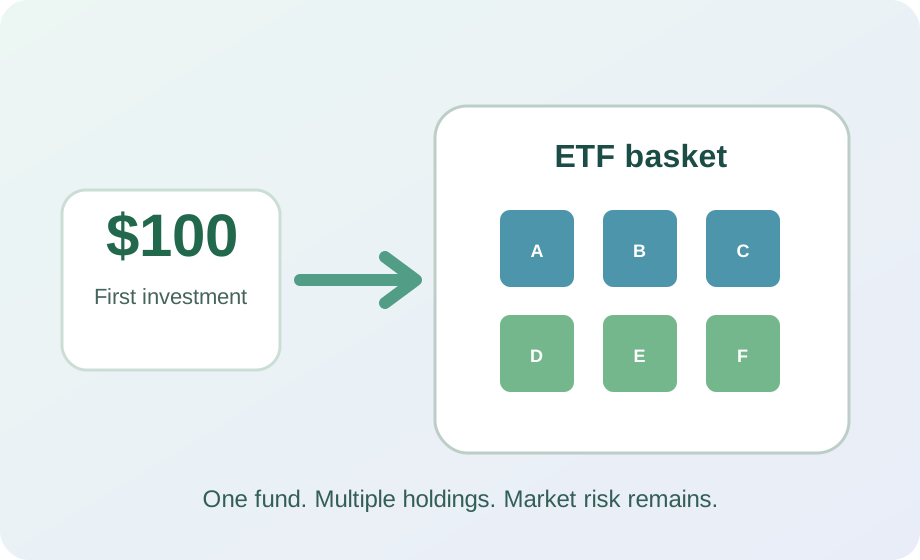
One investment type worth understanding is an ETF, short for exchange-traded fund. Think of an ETF as a basket: instead of buying one company at a time, you can purchase shares of a fund that owns a collection of investments.
What is an ETF in simple words?
An ETF is an investment fund whose shares trade on a stock exchange, much like a stock. Depending on its strategy, it may hold stocks, bonds, or other assets. One ETF may contain hundreds of companies; another may own only a narrow slice of the market.
Imagine a basket holding shares of many businesses. When you buy a share of an ETF, you own a stake in the fund, not direct shares in each company. The fund follows its investment strategy and manages the holdings.
How does an ETF actually work?
- The ETF picks a strategy. Some track an index such as the S&P 500; others are actively managed.
- The fund holds assets. These might include shares of companies, bonds, or other financial instruments.
- You buy ETF shares. You typically place the order through a brokerage account during exchange trading hours.
- The price moves. The ETF's trading price changes as investors trade and as the value of its holdings changes. The market price can be above or below its net asset value (NAV).
Many broad index ETFs are designed for long-term investing, but not every ETF is diversified or beginner-friendly. Leveraged and inverse ETFs, for example, can behave very differently from a simple broad-market fund.
ETFs vs. individual stocks: what is the difference?
| Question | Individual stock | ETF |
|---|---|---|
| What are you buying? | Ownership in a single company | Shares of a fund holding investments |
| How diversified? | One business | Depends on the fund's actual holdings |
| How does it trade? | On an exchange | On an exchange |
| Can the value fall? | Yes | Yes |
| What costs matter? | Potential broker or trading costs | Fund expense ratio plus possible trading costs |
A diversified ETF can reduce the risk that a single company determines your entire result. It does not remove overall market risk.
Can you really start investing in ETFs with $100?
Often, yes. Some ETF shares cost less than $100. Other ETFs cost more than $100 per share, but certain brokers offer fractional ETF shares, letting you invest a fixed dollar amount rather than purchasing a whole share. Fractional-share availability, order rules, and minimums depend on the broker and the ETF.
A simple $100 example
Imagine you have $100 available after covering near-term bills and an appropriate emergency cushion. You choose a diversified ETF you understand, confirm your brokerage offers dollar-based orders, and invest $100. If the ETF rises 5%, the holding would be worth about $105; if it falls 5%, it would be about $95, ignoring fees and other changes. Both directions are possible.
If investing $100 now would leave you short on essentials or force you to take high-interest debt, building cash savings first may be more appropriate. See our save-or-invest-first guide.
What kinds of ETFs do beginners encounter?
- Broad U.S. stock market ETFs: funds that provide exposure to many U.S. companies.
- S&P 500 ETFs: funds seeking to track a large-company U.S. stock index, such as VOO, IVV, and SPY. They are examples, not personal recommendations.
- International stock ETFs: exposure to companies outside the United States.
- Bond ETFs: portfolios of fixed-income securities with risks including interest-rate and credit risk.
- Sector or thematic ETFs: narrow industry or theme exposure that may be more concentrated.
Not all ETFs follow an index. For the distinction between ETFs and index mutual funds, read Index Funds vs. ETFs. For one specific S&P 500 ETF, read What Is VOO?.
How much do ETFs cost?
ETFs typically charge an annual expense ratio, paid indirectly from fund assets rather than as a separate annual bill. For example, a hypothetical 0.10% annual expense ratio corresponds to about $1 per year on a $1,000 balance before allowing for changing fund values. This is an illustration, not a quoted fee for any particular ETF.
Other costs may include brokerage commissions, bid-ask spreads, and paying more than the fund's NAV when buying. Costs vary. Compare each fund's prospectus, strategy, holdings, trading spread, and fees, not just the share price.
How to buy your first ETF: a six-step checklist
- Know the goal. Decide whether the money is for retirement many years away or a shorter-term need.
- Choose the account. Compare a taxable brokerage with available retirement accounts, considering eligibility and tax rules.
- Look for diversification. Read what the fund actually owns and how concentrated it is.
- Review costs and risks. Read the prospectus and expense ratio; avoid buying based only on an appealing ticker.
- Check the trading features. Confirm fractional-share access, order types, fees, and any minimums with your brokerage.
- Build a sustainable habit. If it fits your budget, consider contributing regularly rather than trying to predict the perfect market entry.
Our start-investing-with-$100 guide goes deeper into setting up your first investment, and the dollar-cost averaging guide explains the regular-contribution approach.
What might $100 a month become?
Suppose you invest $100 at the end of every month for 30 years. With a hypothetical steady 7% annual return, compounded monthly, the mathematical future value is approximately $122,000 on $36,000 contributed. Actual market returns fluctuate and can be negative; the illustration ignores taxes, fees, and inflation and is not a forecast.
Change the contribution, duration, and assumed rate in our retirement calculator. The point is not that 7% is guaranteed—it is that consistent contributions and time can be powerful, while market risk remains real.
ETF mistakes to avoid
- Assuming every ETF is low-risk or well-diversified.
- Picking a fund solely because its shares seem inexpensive.
- Ignoring annual fees, trading spreads, or fund objectives.
- Chasing recent performance or treating an ETF as a guaranteed savings product.
- Investing money you will need for near-term bills or emergencies.
Frequently asked questions
Is an ETF the same as a stock?
No. A stock usually represents ownership in one company; an ETF holds a portfolio of investments. Some specialty ETFs are concentrated, so check the holdings.
Can I invest $100 in an ETF?
Yes, if a full share costs $100 or less or your brokerage offers fractional ETF shares. Brokerage features and minimums vary.
Can an ETF lose money?
Yes. An ETF can decline in value and is not guaranteed or FDIC insured.
Do ETFs pay dividends?
Some do, depending on their holdings. Distributions can change and are not guaranteed.
Is every ETF an S&P 500 index fund?
No. ETFs can track many indexes or use active strategies and can invest in stocks, bonds, or other assets.
The bottom line
An ETF makes it possible to buy a fund through a brokerage account, often gaining exposure to many investments at once. Starting with $100 may be feasible, especially when fractional shares are available, but you still need to examine what the fund owns, the risks, the costs, and how it fits your goals.
Keep learning
Next, compare index mutual funds and ETFs, understand VOO, or experiment with the retirement calculator.
Sources and further reading
- Investor.gov — Exchange-Traded Funds (ETFs)
- Investor.gov — Updated Investor Bulletin: ETFs
- Investor.gov — ETF Fees and Expenses
Disclaimer: For educational purposes only. This article is not individualized financial, tax, or investment advice. All investments involve risk, including possible loss of principal.